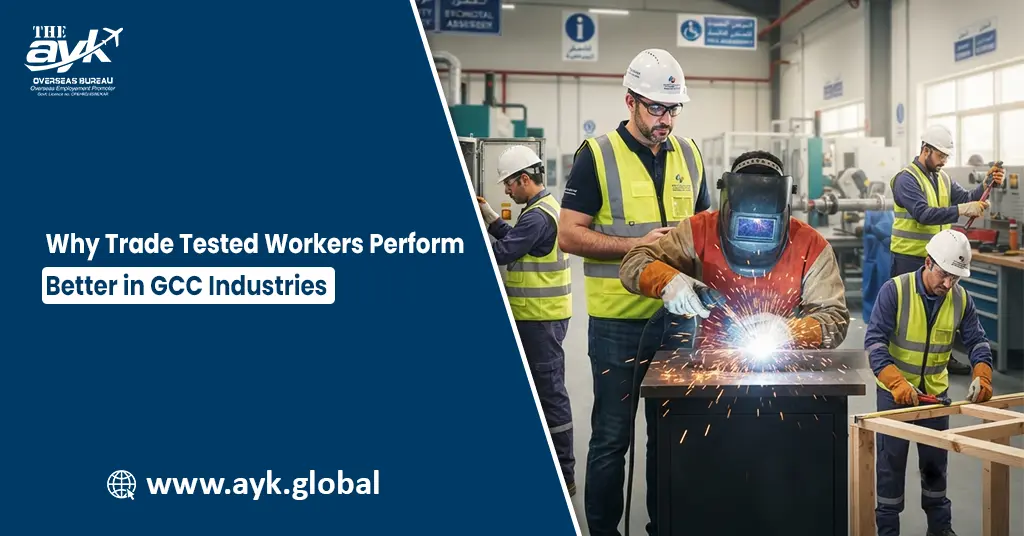
Why Trade-Tested Workers Perform Better in GCC Industries
Published: July 03, 2026 | Views: 13
Introduction
GCC industries such as construction, oil and gas, infrastructure development, manufacturing, logistics, and facility management depend heavily on skilled labor from international markets. Countries like Saudi Arabia, the United Arab Emirates, Qatar, Kuwait, Oman, and Bahrain continuously invest in mega projects that require a highly skilled, disciplined, and efficient workforce. In such a competitive and fast-paced environment, the quality of manpower directly affects project timelines, safety standards, and overall productivity.
One of the most important factors that determines workforce quality is trade testing. Trade-tested workers are those who have undergone practical skill evaluation before being hired for overseas employment. Instead of relying only on CVs or interviews, employers assess real technical abilities through hands-on tests. This ensures that only qualified and job-ready candidates are selected. As a result, trade-tested workers consistently perform better in GCC industries because they are verified, skilled, and prepared for real job conditions.
Higher Skill Accuracy and Job Readiness
Trade-tested workers perform better because their skills have already been verified before deployment. Unlike non-tested candidates, they have demonstrated their technical abilities in real working conditions. This ensures that they are fully job-ready from day one, without requiring extensive training or supervision.
In GCC industries where projects run on strict deadlines, job readiness is extremely important. Workers such as welders, electricians, plumbers, masons, and heavy equipment operators must perform tasks accurately and efficiently. Trade testing ensures that only those who meet international skill standards are selected, resulting in higher work quality and reduced errors on-site.
Improved Productivity on Construction and Industrial Sites
Productivity is a key success factor in GCC mega projects. Trade-tested workers contribute significantly to higher productivity because they already understand job requirements and technical procedures. They can perform tasks faster, more efficiently, and with fewer mistakes compared to untested workers.
Since they have been evaluated in practical environments, they are also more confident in handling tools, machinery, and complex tasks. This reduces downtime, improves workflow efficiency, and helps projects stay on schedule. In large-scale industries, even small productivity improvements can lead to significant time and cost savings.
Better Safety Compliance and Reduced Workplace Accidents
Safety is a top priority in GCC industries, especially in high-risk environments such as construction sites, oil rigs, and manufacturing plants. Trade-tested workers are generally more aware of safety procedures because they are evaluated not only on skill but also on safety practices during testing.
They understand how to handle tools properly, follow safety protocols, and avoid risky behaviors that could lead to accidents. This reduces workplace incidents, protects equipment, and ensures compliance with international safety standards. Safer workplaces also lead to fewer project delays and lower insurance and compensation costs.
Reduced Training Time and Faster Onboarding
Trade-tested workers require significantly less training compared to non-tested candidates because their practical skills have already been assessed before hiring. In GCC industries, where project timelines are strict and delays are costly, reducing onboarding time is a major advantage.
Since these workers already understand tools, machinery, and job procedures, they can start working almost immediately after arrival. Employers only need to provide site-specific orientation and safety induction instead of full technical training. This leads to faster deployment, quicker project execution, and better use of manpower from day one.
Lower Recruitment Risks and Hiring Errors
One of the biggest challenges in overseas recruitment is hiring candidates who look qualified on paper but lack real technical skills. Trade testing eliminates this risk by verifying actual performance before selection. This ensures that only competent workers are hired for GCC industries.
By filtering out unskilled or underqualified candidates early in the process, employers reduce costly hiring mistakes such as visa wastage, travel expenses, and early employee replacement. This improves recruitment accuracy and ensures that every hired worker contributes effectively to project success.
Higher Work Quality and Reduced Rework
Trade-tested workers consistently deliver better work quality because they have demonstrated their skills under evaluation conditions. Their accuracy in performing technical tasks such as welding, electrical wiring, pipe fitting, or machinery operation results in fewer errors on-site.
In GCC industries, poor-quality work often leads to rework, which increases project costs and delays completion. Trade-tested workers help minimize such issues by ensuring that tasks are completed correctly the first time. This improves overall project efficiency and reduces material wastage and operational expenses.
Cost Efficiency in Long-Term Workforce Management
Although trade testing adds an initial step in recruitment, it significantly reduces long-term costs for GCC employers. Hiring skilled and verified workers prevents expensive issues such as repeated recruitment cycles, project delays, training costs, and workplace accidents.
Since trade-tested workers perform better and stay productive longer, employers save money on supervision, correction work, and replacement hiring. This makes trade testing a cost-effective strategy for managing large-scale industrial and construction workforces.
Better Workforce Stability and Retention
Trade-tested workers are more likely to stay longer in their jobs because they are properly matched to roles that suit their skills. When workers are placed in positions aligned with their abilities, job satisfaction increases and turnover rates decrease.
In GCC industries, high employee turnover can disrupt project timelines and increase recruitment costs. By ensuring better job matching through trade testing, employers achieve a more stable workforce, reducing disruptions and maintaining consistent project progress.
Conclusion
Trade-tested workers perform better in GCC industries because they bring verified skills, higher efficiency, improved safety awareness, and stronger job readiness. They reduce recruitment risks, improve work quality, and help employers complete projects faster and more cost-effectively.
For GCC employers, trade testing is not just an optional step—it is a critical quality assurance tool that ensures workforce reliability in high-demand industrial environments. As industries continue to grow across the Gulf region, trade-tested manpower will remain essential for achieving operational excellence and long-term project success.
 How Recruitment Agencies Save Time and Hiring Costs
 Bahrain Job Market: Opportunities and How to Get In
 KSA Recruitment
 UAE Recruitment
 Qatar Recruitment
 Oman Recruitment
 Kuwait Recruitment
 Libya Recruitment
 Bahrain Recruitment
 Iraq Recruitment
 Malaysia Recruitment
 Malta Recruitment
 Canada Recruitment
 USA Recruitment
 Europe Recruitment
 UK Recruitment
 Romania Recruitment
 Poland Recruitment
 Bulgaria Recruitment
 Albania Recruitment
 Serbia Recruitment
 Lithuania Recruitment
 Japan Recruitment
 Turkey Recruitment
 Kyrgyzstan Recruitment
 South Korea Recruitment