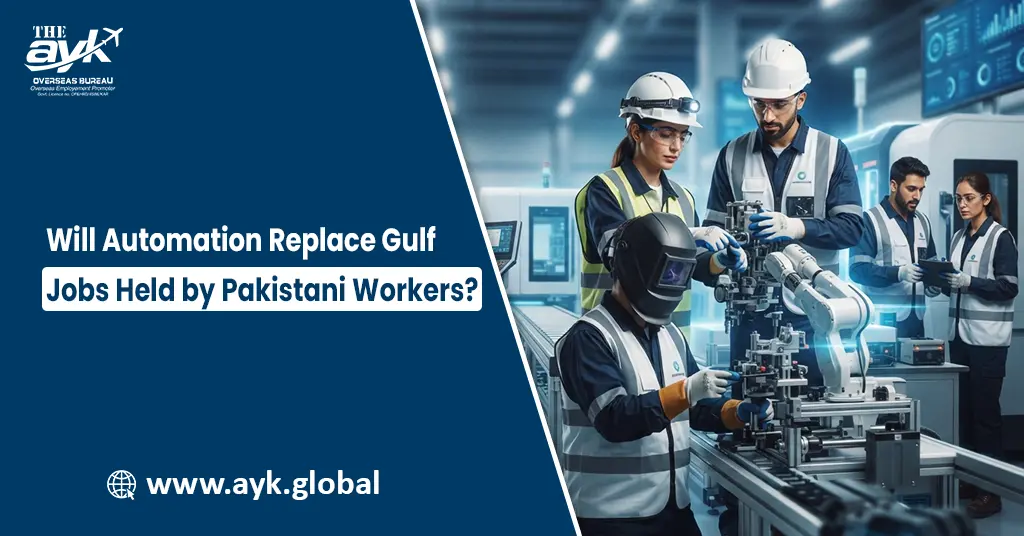
Will Automation Replace Gulf Jobs Held by Pakistani Workers?
Published: July 04, 2026 | Views: 12
Introduction
The question of whether automation will replace Gulf jobs held by Pakistani workers has moved from speculative future concern to a genuinely relevant present-day consideration as Gulf countries accelerate their technology adoption investments across construction, logistics, hospitality, manufacturing, and various other sectors where Pakistani workers have historically found substantial employment. Understanding how automation is actually affecting Gulf employment demand, which specific job categories face genuine displacement risk, and which roles remain stubbornly resistant to automation despite technology advancement provides workers and families with the realistic picture they need to make informed career development decisions rather than either dismissing automation concerns as irrelevant or catastrophizing inevitable job losses that honest analysis does not support. AYK Overseas Recruitment & HR Manpower Agency, recognized as one of Pakistan's top manpower agencies, monitors Gulf employment demand patterns and this guide provides our honest assessment of automation's actual and likely impact on Pakistani worker employment across different Gulf employment categories.
The Current Reality of Automation in Gulf Workplaces
Gulf countries are genuinely investing substantially in workplace automation across multiple sectors, with Saudi Arabia, UAE, and Qatar all making significant automation technology investments as part of broader economic modernization strategies that seek to improve productivity, reduce labor costs, and position their economies competitively within global markets that increasingly reward automation-enhanced operational efficiency. However, the pace and scope of automation's actual impact on employment has generally been more gradual and selective than dramatic predictions often suggest, with automation typically affecting specific task components within jobs rather than eliminating entire job categories simultaneously, creating transitions in how work is performed rather than immediate wholesale elimination of employment categories that panic-inducing automation discourse sometimes implies. Pakistani workers should approach automation awareness with honest realism that acknowledges genuine displacement risks in specific categories without accepting exaggerated claims that suggest all manual and technical employment will disappear within timeframes that current technology adoption trajectories simply do not support.
Jobs at Highest Automation Risk in Gulf Markets
Certain Gulf employment categories held by Pakistani workers face genuine, meaningful automation displacement risk based on the characteristics of tasks involved and the current state of commercially available automation technology that Gulf employers are actively adopting, including simple repetitive manual assembly and processing tasks in manufacturing facilities, basic data entry and document processing roles in administrative contexts, certain warehouse picking and sorting functions where robotics systems are becoming commercially viable for Gulf-scale operations, and some transportation and logistics coordination roles where software automation is progressively handling route optimization and shipment tracking functions previously performed by human coordinators. Workers in these higher-risk categories should honestly assess their employment's automation vulnerability rather than dismissing the risk, recognizing that gradual displacement through task automation that requires fewer workers for the same output can create employment reductions over years rather than dramatic sudden job eliminations that would be more immediately obvious warning signals requiring response.
Construction Sector Automation Realities
Gulf construction employment, which represents one of the largest Pakistani worker employment categories in the region, faces genuine but more limited near-term automation impact compared to some other employment sectors, with construction's physical complexity, environmental variability, and coordination intensity creating genuine technical challenges for automation that make complete construction site robotization a longer-term rather than near-term prospect despite active research investment in construction automation technology. Current construction automation deployments primarily affect specific task categories including concrete pouring through pump systems that reduce labor requirements, bricklaying through emerging robotic systems with limited current commercial deployment, and site inspection through drone technology that supplements rather than replaces human inspector capability, leaving the majority of skilled construction trade work as predominantly human-executed employment for the foreseeable horizon relevant to current workers' career planning. Pakistani construction workers should monitor automation developments within their specific trade specializations rather than assuming either complete immunity or imminent displacement, developing the technology operation familiarity that allows them to work alongside automation systems as enhanced human-technology teams rather than as purely manual labor that automation could theoretically replace entirely.
Hospitality and Service Sector Automation Considerations
Gulf hospitality employment faces selective automation pressure primarily in back-of-house operations rather than the guest-facing human service interactions that represent the core value proposition of premium hospitality, with food and beverage preparation automation, housekeeping robot development, and automated check-in systems creating displacement pressure in specific operational roles while actually expanding human employment needs in guest experience management, technology maintenance, and quality oversight functions that automation systems create alongside the tasks they automate. Pakistani hospitality workers in roles that involve genuine human guest interaction, personalized service delivery, and the judgment-intensive human relationship management that premium hospitality fundamentally requires are considerably less automation-threatened than those in purely mechanical, repetitive operational roles that automation technology is progressively capable of executing at acceptable commercial quality levels. Workers in Gulf hospitality should develop their human service excellence capabilities as their most automation-resistant competitive advantage, recognizing that the specifically human qualities of empathy, cultural sensitivity, and genuine personal service that premium hospitality guests value most highly represent capabilities that current automation technology cannot meaningfully replicate regardless of its mechanical operational efficiency in specific back-of-house functions.
Technology Maintenance as Growing Employment Opportunity
One of the less discussed but genuinely important employment trend implications of Gulf automation investment involves the growing demand for technical workers capable of maintaining, programming, troubleshooting, and managing the automated systems that Gulf employers are adopting, creating new employment categories that partially offset displacement from automated tasks while also requiring different technical skill profiles than the manual labor capabilities that automated systems are replacing. Pakistani workers with electronics, mechanical, and emerging digital technical backgrounds who develop relevant automation system familiarity are well positioned to access this growing maintenance and technical oversight employment demand that automation investment creates alongside its displacement effects, representing a genuine opportunity for workers who approach automation with curiosity and skill development orientation rather than purely defensive resistance. The specific automation maintenance skill requirements vary between different system types and sectors, making targeted technical education investment in the specific automation technologies most actively deployed within a worker's target employment sector more valuable than generic automation awareness without the specific system-level knowledge that actual maintenance employment requires.
Skills That Make Workers Automation-Resistant
Certain specific skill and competency profiles create meaningful automation resistance that protects employment across Gulf employment sectors regardless of the overall automation investment levels within those sectors, including genuine problem-solving capability that responds adaptively to non-routine situations that automation handles poorly, strong interpersonal and communication skills that create human relationship value in customer-facing and team coordination contexts that automation cannot meaningfully substitute, specialized technical expertise that requires judgment developed through varied complex experience rather than pattern-following that automation systems can learn, and physical dexterity in complex, variable environments that current robotics cannot match human performance levels in despite significant research investment. Pakistani workers who deliberately develop these automation-resistant competencies alongside their core technical skills create more durable career positioning than those who develop strong performance in highly routine, repetitive tasks that automation technology most efficiently and reliably replaces without the judgment, adaptability, and interpersonal capability that human workers provide most distinctively relative to current automation technology capabilities.
The Realistic Timeline for Automation Impact
Honest timeline assessment of automation's Gulf employment impact requires distinguishing between the commercially deployed automation creating actual current employment effects and the research-stage or emerging automation that creates speculative future displacement concern without near-term commercial deployment that would affect current workers' employment within their realistic career planning horizon. Most Gulf sector automation currently affecting Pakistani worker employment involves technology that reduces labor requirements per output unit rather than eliminating entire employment categories, creating gradual rather than sudden employment reductions that give workers with adequate awareness time to develop adaptive responses through skill development and career positioning adjustments. Workers with ten to twenty year career horizons in Gulf employment face more meaningful automation exposure requiring proactive skill adaptation than workers closer to the conclusion of their planned overseas employment period for whom near-term automation developments may not create significant practical employment disruption within their specific remaining employment timeframe.
How Gulf Governments' Automation Policies Affect Pakistani Workers
Gulf government policies toward automation investment and labor market management significantly affect how automation impacts actually translate into Pakistani worker employment, with governments balancing automation productivity benefits against the employment continuity interests of their substantial overseas worker populations whose remittances support home country economies that Gulf governments maintain political relationships with. Saudi Arabia's Vision 2030, UAE's economic diversification initiatives, and Qatar's post-World Cup economic strategy all include automation investment components alongside continued recognition of overseas labor's economic role, creating policy environments that encourage automation adoption in productivity-enhancing directions without the immediate wholesale workforce replacement that unconstrained automation investment without labor market policy consideration might otherwise produce. Pakistani workers should monitor Gulf government policy developments relevant to their employment categories, recognizing that labor market policies including minimum hiring quotas, Omanization and Saudization requirements, and worker welfare regulations all interact with automation economics in ways that affect how quickly and completely automation can practically replace human workers despite its technical capability to do so in specific task categories.
Preparing for an Automated Future Without Panic
Workers who approach Gulf automation developments with informed, proactive adaptation mindset rather than either denial or panic create the most practically useful personal response to a genuinely significant but not catastrophically immediate employment environment change that requires thoughtful navigation rather than dramatic career abandonment or complete dismissal of legitimate future concerns. The most productive response to automation awareness involves identifying specific competencies that provide meaningful automation resistance within the worker's existing trade or professional area, developing genuine familiarity with the technology systems being adopted within their sector, and building the broader professional portfolio that creates career flexibility across related employment areas when specific task categories within their current employment become progressively automated over time. Workers should seek specific current information about automation adoption within their particular trade and Gulf destination from their recruitment agency, community members with current Gulf employment experience, and sector-specific professional networks that provide more accurate real-time intelligence about actual automation impact than general media coverage that sometimes either sensationalizes imminent displacement or dismisses legitimate gradual employment effects without adequate consideration.
How AYK Overseas Monitors Automation Trends for Candidate Guidance
As a government-licensed international recruitment and HR manpower firm with offices in Karachi and Islamabad, AYK Overseas Recruitment & HR Manpower Agency monitors Gulf employment demand patterns including automation's actual impact on hiring across different employment categories, providing candidates with honest, current assessment of their specific employment category's automation exposure as part of comprehensive career guidance that serves workers' genuine long-term interests. Being recognized as one of Pakistan's top manpower agencies, we advise candidates on skill development priorities that build automation resistance within their professional profiles, helping workers approach their Gulf employment career with the adaptive orientation and specific capability development that creates durable career positioning across the evolving Gulf employment landscape that automation investment is genuinely reshaping across multiple employment sectors over the coming decade.
Conclusion
Automation will genuinely affect Gulf employment held by Pakistani workers across various categories over the coming years, with meaningful displacement risk concentrated in highly routine, repetitive task categories while skilled trades, human service roles, and judgment-intensive technical employment demonstrate considerably more automation resistance that protects career durability for workers who develop the specific competencies that automation cannot currently replicate. Workers who develop honest automation awareness, build automation-resistant skills alongside their core technical capabilities, develop familiarity with automated systems that creates maintenance and oversight employment opportunity, and maintain adaptive career development orientation are well positioned to navigate the genuinely evolving Gulf employment landscape without the paralysis that excessive automation anxiety creates or the vulnerability that complete automation denial produces.
 Ultimate Guide to GCC Jobs for Pakistanis, Visa, Salary, Recruitment and Career Growth
 Benefits of Outsourcing Recruitment to a Manpower Agency
 Scaffolding Jobs in GCC Countries for Pakistani Workers
 KSA Recruitment
 UAE Recruitment
 Qatar Recruitment
 Oman Recruitment
 Kuwait Recruitment
 Libya Recruitment
 Bahrain Recruitment
 Iraq Recruitment
 Malaysia Recruitment
 Malta Recruitment
 Canada Recruitment
 USA Recruitment
 Europe Recruitment
 UK Recruitment
 Romania Recruitment
 Poland Recruitment
 Bulgaria Recruitment
 Albania Recruitment
 Serbia Recruitment
 Lithuania Recruitment
 Japan Recruitment
 Turkey Recruitment
 Kyrgyzstan Recruitment
 South Korea Recruitment