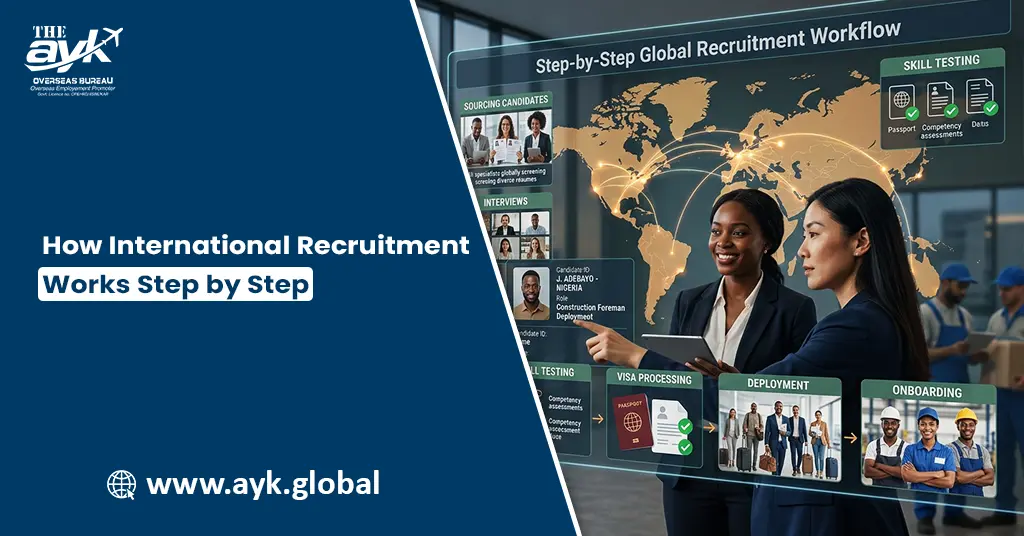
How International Recruitment Works Step by Step
Published: June 22, 2026 | Views: 41
Introduction
International recruitment has become one of the most effective workforce solutions for employers facing labor shortages, rapid business expansion, specialized skill requirements, and large-scale project demands. Across industries such as construction, healthcare, oil and gas, logistics, hospitality, manufacturing, facilities management, engineering, and transportation, organizations increasingly rely on overseas hiring to secure the talent needed for growth and operational success.
However, many employers are unfamiliar with how international recruitment actually works. Unlike local hiring, overseas recruitment involves multiple stages, including workforce planning, candidate sourcing, screening, trade testing, documentation, compliance management, visa processing, mobilization, deployment, and onboarding. Each stage must be managed carefully to ensure successful workforce acquisition and long-term employee performance.
A structured international recruitment process helps employers reduce hiring risks, improve workforce quality, and maintain compliance with labor regulations. Professional recruitment agencies play an important role by coordinating activities, managing documentation, and supporting workforce deployment across borders.
This guide explains how international recruitment works step by step and how employers can build successful overseas hiring strategies.
1. Workforce Planning and Hiring Requirement Analysis
Every successful international recruitment project begins with workforce planning. Before sourcing candidates, employers must clearly define what type of workforce they need, how many employees are required, what qualifications are necessary, and when deployment must occur. Workforce planning provides direction for all recruitment activities and helps ensure that hiring efforts align with business objectives.
Organizations often experience recruitment challenges when workforce requirements are not defined properly. Unclear job roles, unrealistic expectations, and inconsistent hiring criteria can delay recruitment and reduce candidate quality. Employers should therefore conduct detailed workforce assessments before launching international hiring campaigns.
Workforce planning also involves evaluating project timelines, operational goals, budget considerations, and future staffing needs. Companies that plan strategically are better positioned to manage recruitment efficiently and avoid workforce shortages. This planning phase often determines the overall success of the recruitment project.
Professional recruitment agencies typically begin engagements with workforce consultations. Agencies such as AYK Overseas Recruitment & HR Manpower Agency (License No. GL-4586-KAR) work closely with employers to understand workforce requirements and develop recruitment strategies that support organizational objectives.
Why Workforce Planning Is Important
Clear workforce requirements improve recruitment accuracy.
Strategic planning reduces hiring delays and workforce shortages.
Employers gain greater control over recruitment outcomes.
2. Creating Job Descriptions and Recruitment Specifications
Once workforce requirements have been identified, the next step involves developing detailed job descriptions and recruitment specifications. These documents help recruiters understand exactly what type of candidates should be sourced and evaluated.
A strong job description outlines responsibilities, qualifications, technical competencies, reporting relationships, experience requirements, and performance expectations. Recruitment specifications may also include language requirements, certifications, physical fitness standards, salary ranges, and deployment conditions.
Accurate job descriptions improve recruitment effectiveness because they establish clear expectations for both candidates and recruiters. When requirements are defined precisely, candidate sourcing becomes more targeted and efficient. This reduces the likelihood of attracting unsuitable applicants.
Employers should review job descriptions carefully before recruitment begins. Clear role definitions contribute to stronger candidate quality and support more successful workforce integration after deployment.
Recruitment Specifications Matter
Detailed role definitions improve candidate targeting.
Clear expectations reduce recruitment confusion.
Strong job descriptions support better workforce quality.
3. Candidate Sourcing Through International Talent Networks
After recruitment requirements have been established, agencies begin candidate sourcing. This stage involves identifying potential applicants who meet workforce requirements and are interested in international employment opportunities.
Professional recruitment agencies maintain extensive talent databases and workforce networks developed over many years. These resources allow recruiters to access qualified candidates quickly without relying solely on public job advertisements. Agencies often use referrals, workforce partnerships, online platforms, industry contacts, and talent pools to identify suitable applicants.
International sourcing provides employers with access to larger labor markets. Instead of limiting recruitment efforts to local candidates, organizations can reach skilled professionals across multiple countries and workforce categories. This significantly increases hiring flexibility and workforce availability.
Candidate sourcing is one of the most important stages of international recruitment because workforce quality depends heavily on sourcing effectiveness. Strong sourcing strategies improve candidate quality and accelerate recruitment timelines.
Benefits of International Sourcing
Global talent access expands workforce options.
Large candidate networks improve hiring flexibility.
Professional sourcing supports faster recruitment.
4. Initial Screening and Candidate Shortlisting
Once candidates have been sourced, recruiters begin screening activities. Screening helps identify applicants who meet workforce requirements while eliminating unsuitable candidates early in the recruitment process.
Initial screening often includes application reviews, resume assessments, qualification verification, communication evaluations, and preliminary interviews. Recruiters assess candidate suitability based on experience, technical competencies, language abilities, and employment readiness.
Shortlisting is one of the most valuable recruitment services because it saves employers significant time. Instead of reviewing hundreds of applications, organizations receive a smaller group of qualified candidates who align with established hiring criteria.
Effective screening improves workforce quality and reduces hiring risks. Candidates who progress to later stages have already undergone substantial evaluation, increasing confidence in recruitment outcomes.
Why Screening Is Essential
Screening improves candidate quality.
Shortlisting saves time for employers.
Early evaluation reduces hiring risks.
5. Interviews and Employer Selection Process
Interviews provide employers with an opportunity to evaluate candidates more thoroughly. While resumes and applications provide background information, interviews reveal communication skills, professionalism, problem-solving abilities, and overall suitability for the role.
Recruitment agencies often conduct preliminary interviews before presenting candidates to employers. These assessments help confirm qualifications and ensure that candidates meet workforce requirements. Employers then conduct final interviews to make hiring decisions.
Interview processes vary depending on industry and role requirements. Technical positions may involve competency-based assessments, while customer-facing roles may emphasize communication and interpersonal skills. Structured interviews generally produce more reliable hiring outcomes.
Candidate selection should consider both technical qualifications and organizational fit. Employers that evaluate candidates comprehensively often experience stronger workforce performance and retention.
Interview Benefits
Interviews provide deeper candidate insight.
Structured evaluation improves hiring accuracy.
Comprehensive assessment supports workforce quality.
6. Trade Testing and Skills Verification
For many workforce categories, practical skills are more important than educational qualifications. International recruitment agencies frequently conduct trade testing to verify technical competencies before workforce deployment.
Trade testing is particularly valuable when recruiting welders, electricians, plumbers, HVAC technicians, fabricators, machine operators, maintenance personnel, and other skilled workers. Practical assessments allow employers to evaluate workforce competence objectively.
Skills verification reduces hiring risks because employers gain direct evidence of candidate capabilities. Workers who pass trade tests are generally more productive and require less supervision after deployment.
Employers should prioritize recruitment partners that support skills verification. Trade testing improves workforce quality and contributes to stronger operational performance.
Value of Trade Testing
Practical assessments confirm workforce competence.
Trade-tested workers often perform more effectively.
Skills verification reduces recruitment risks.
7. Reference Checks and Background Verification
After interviews and trade testing have been completed, the next stage of international recruitment involves reference checks and background verification. Many employers make the mistake of assuming that a strong interview automatically guarantees a reliable employee. However, international recruitment often requires significant investments in documentation, visa processing, accommodation arrangements, travel expenses, and onboarding activities. Because of these investments, employers must verify candidate information carefully before making final hiring decisions.
Reference checks help confirm employment history, workplace performance, attendance records, technical capabilities, and professional conduct. Previous employers can often provide valuable insights that are not visible through resumes or interviews. This information helps employers identify potential concerns before workforce deployment takes place.
Background verification also supports compliance and workforce quality objectives. Qualification certificates, professional licenses, training records, and identification documents should be reviewed thoroughly. Verifying these records protects employers from fraudulent applications and reduces recruitment risks.
Organizations that implement structured verification procedures generally experience stronger hiring outcomes and lower turnover rates. Verification increases confidence in recruitment decisions and helps ensure that workforce investments generate positive long-term returns.
Why Verification Is Important
Reference checks provide independent confirmation of candidate experience.
Background verification reduces recruitment risks.
Verified workforce data supports stronger hiring decisions.
8. Documentation and Compliance Management
Documentation management is one of the most critical stages of international recruitment. Even highly qualified candidates cannot be deployed successfully if documentation requirements are not completed accurately. Employers must therefore ensure that all recruitment records are collected, reviewed, and processed according to applicable regulations.
International recruitment generates a significant volume of documentation. This may include passports, educational certificates, employment records, trade licenses, medical reports, employment contracts, visa applications, and government approvals. Missing or incorrect documentation can delay recruitment projects and increase administrative costs.
Compliance management is equally important because labor regulations vary across countries. Employers must ensure that recruitment activities comply with immigration laws, employment standards, workforce regulations, and destination-country requirements. Failure to meet these obligations can create legal and operational challenges.
Professional recruitment agencies help employers manage documentation and compliance efficiently. Their expertise reduces administrative burdens and supports smoother workforce mobilization. Employers benefit from reduced risk and improved recruitment efficiency.
Compliance Supports Recruitment Success
Accurate documentation reduces delays.
Compliance protects employers from legal risks.
Professional documentation management improves workforce readiness.
9. Visa Processing and Immigration Procedures
Visa processing is one of the most important stages in international recruitment because it determines whether workers can legally enter and work in the destination country. Immigration procedures vary significantly depending on workforce category, employer requirements, and government regulations.
Employers must often submit employment contracts, labor approvals, company documents, candidate records, and supporting evidence as part of visa applications. Government authorities review these materials before granting work authorization. Processing timelines vary and may depend on destination-country policies and workforce demand.
Professional recruitment agencies play a valuable role by coordinating visa procedures and ensuring that documentation requirements are met. Agencies monitor application progress, communicate with relevant authorities, and help resolve issues that may arise during processing.
Successful visa management requires careful planning because delays can affect project schedules and workforce deployment timelines. Employers that work with experienced recruitment agencies often achieve more predictable recruitment outcomes and improved workforce readiness.
Why Visa Management Matters
Work authorization is essential for legal employment.
Professional coordination reduces processing delays.
Efficient visa management supports workforce deployment schedules.
10. Workforce Mobilization and Travel Coordination
Once visas and approvals have been secured, attention shifts to workforce mobilization. Mobilization refers to all activities required to prepare employees for international deployment. This stage often includes travel planning, accommodation arrangements, pre-departure briefings, medical examinations, and final documentation reviews.
Workforce mobilization requires detailed coordination because multiple activities must occur within specific timelines. Employers need workers to arrive on schedule and begin contributing to operations as quickly as possible. Delays during mobilization can affect project deadlines and increase operational costs.
Recruitment agencies frequently coordinate travel arrangements and communicate deployment schedules to candidates. They help ensure that employees understand destination-country requirements, workplace expectations, and travel procedures before departure. This preparation improves workforce readiness and reduces transition challenges.
Organizations that invest in structured mobilization processes generally experience smoother workforce deployment and stronger employee integration. Effective mobilization contributes directly to recruitment success.
Mobilization Creates Workforce Readiness
Preparation improves deployment efficiency.
Travel coordination reduces operational disruptions.
Structured mobilization supports workforce productivity.
11. Deployment, Onboarding, and Workforce Integration
Recruitment does not end when employees arrive at their destination. Workforce deployment and onboarding are equally important because they influence how quickly workers adapt to their new environment and become productive members of the organization.
Onboarding introduces employees to workplace procedures, organizational expectations, reporting structures, safety requirements, and operational standards. Effective onboarding programs help workers understand their responsibilities and reduce uncertainty during the transition period.
Workforce integration also affects retention. Employees who receive adequate support during onboarding generally feel more confident and engaged. This improves job satisfaction and contributes to stronger long-term workforce stability. Organizations that neglect onboarding often experience higher turnover rates and slower productivity growth.
Recruitment agencies frequently support deployment activities by maintaining communication with employers and employees during the early stages of employment. This additional support helps address challenges quickly and improves workforce outcomes.
Why Onboarding Matters
Onboarding accelerates workforce productivity.
Structured integration improves employee confidence.
Strong onboarding supports retention and workforce stability.
12. Long-Term Workforce Management and Retention
Successful international recruitment extends beyond hiring and deployment. Employers must also focus on workforce retention, employee development, and long-term workforce management. Recruiting talented employees provides limited value if organizations cannot retain them effectively.
Retention strategies often include competitive compensation, career development opportunities, supportive management practices, training programs, and positive workplace environments. Employees who feel valued and supported are generally more committed to their organizations and contribute more effectively over time.
Long-term workforce management also involves performance evaluation, workforce planning, succession planning, and employee engagement initiatives. These activities help organizations maximize the value of their recruitment investments and maintain workforce stability.
AYK Overseas Recruitment & HR Manpower Agency (License No. GL-4586-KAR) supports employers through structured recruitment processes that emphasize workforce quality and long-term success. Employers that focus on retention and workforce development often achieve stronger operational performance and sustainable growth.
Long-Term Success Depends on Retention
Retention protects recruitment investments.
Workforce development improves productivity.
Long-term management supports organizational growth.
Conclusion
International recruitment is a structured process that involves far more than simply identifying candidates. Successful overseas hiring requires workforce planning, sourcing, screening, trade testing, verification, documentation management, visa processing, mobilization, deployment, and long-term workforce support.
Organizations that understand these stages and implement structured recruitment processes are more likely to achieve successful hiring outcomes. Professional recruitment agencies provide valuable expertise that helps employers navigate complex international recruitment requirements while reducing risks and administrative burdens.
As global labor markets continue evolving, international recruitment will remain an essential workforce strategy for organizations seeking growth, flexibility, and access to skilled talent.
 WhatsApp Job Scams: How to Identify and Avoid Them
 Quality Control and QA/QC Jobs in GCC Countries
 KSA Recruitment
 UAE Recruitment
 Qatar Recruitment
 Oman Recruitment
 Kuwait Recruitment
 Libya Recruitment
 Bahrain Recruitment
 Iraq Recruitment
 Malaysia Recruitment
 Malta Recruitment
 Canada Recruitment
 USA Recruitment
 Europe Recruitment
 UK Recruitment
 Romania Recruitment
 Poland Recruitment
 Bulgaria Recruitment
 Albania Recruitment
 Serbia Recruitment
 Lithuania Recruitment
 Japan Recruitment
 Turkey Recruitment
 Kyrgyzstan Recruitment
 South Korea Recruitment