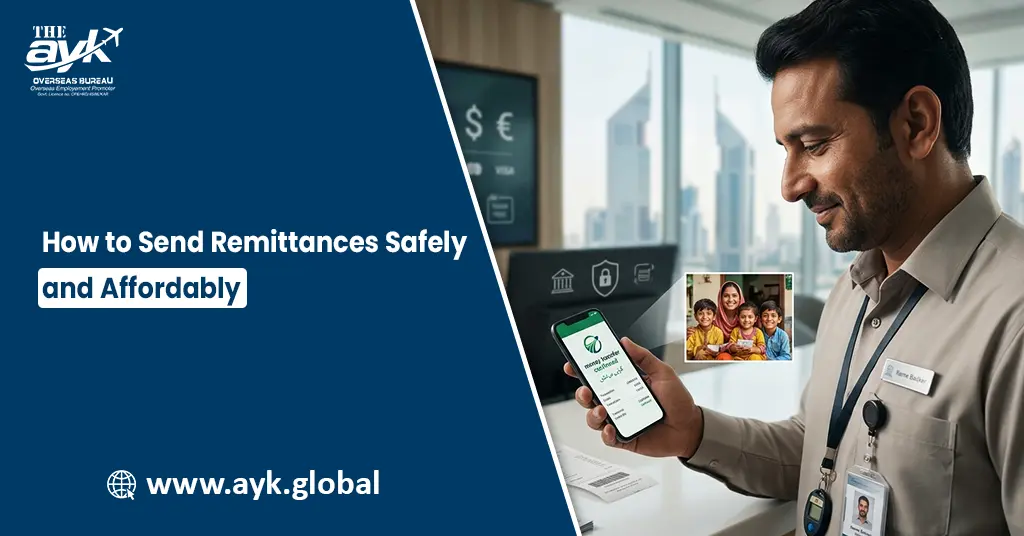
How to Send Remittances Safely and Affordably
Published: June 30, 2026 | Views: 14
Introduction
Sending remittances safely and affordably represents one of the most practical, ongoing concerns for Pakistani overseas workers, given that these regular transfers often represent the primary financial purpose behind pursuing overseas employment in the first place. Understanding how to properly evaluate different transfer options, balancing cost-effectiveness against security and reliability considerations, helps workers maximize the value of their hard-earned income reaching their families back home.
This guide examines practical considerations for choosing remittance services and maintaining secure, affordable transfer practices throughout your overseas employment period. AYK Overseas Recruitment & HR Manpower Agency, recognized as one of Pakistan's top manpower agencies, provides guidance to candidates regarding these practical financial considerations, recognizing their genuine importance to overall overseas employment success.
Understanding Different Remittance Transfer Methods
Workers have access to various remittance transfer methods, including traditional bank transfers, specialized money transfer companies, and increasingly popular mobile money or digital wallet services that have expanded considerably in recent years across both sending and receiving countries. Understanding the basic characteristics of each method category helps workers make more informed decisions about which approach best suits their specific circumstances.
Workers should research which specific services operate effectively between their particular destination country and Pakistan, recognizing that not every remittance service operates across every country corridor, making destination-specific research essential rather than assuming generic global service availability. This research helps workers identify the actual viable options relevant to their specific overseas employment location.
Comparing Transfer Fees Across Different Services
Remittance services typically charge fees through various structures, including flat transaction fees, percentage-based charges, or sometimes built into less favorable exchange rates rather than explicit separate fees, making genuine cost comparison sometimes more complex than simply comparing advertised fee structures alone. Workers should calculate the actual total cost, including both explicit fees and exchange rate considerations, when comparing different service options.
Workers should periodically compare costs across multiple services rather than assuming their initially chosen provider remains the most cost-effective option throughout their entire employment period, since pricing and available services can change over time. This periodic comparison helps ensure workers continue accessing genuinely competitive remittance costs rather than potentially overpaying through inertia alone.
Evaluating Transfer Speed and Reliability
Beyond simple cost considerations, workers should evaluate transfer speed and reliability when choosing remittance services, recognizing that faster, more reliable transfers sometimes justify modestly higher costs particularly for time-sensitive family financial needs. Workers should research typical transfer timing for specific services, understanding realistic expectations regarding how quickly funds typically become available to recipients after sending.
Workers should also consider service reliability track record, perhaps through researching online reviews or asking colleagues about their actual experience with specific remittance providers, since reliability problems creating delayed or complicated transfers can create significant family financial stress regardless of how competitive the advertised pricing might appear. This reliability consideration helps workers choose services that genuinely deliver consistent, dependable performance.
Understanding Exchange Rate Considerations
Exchange rates significantly affect the actual value your family receives from remitted funds, making it important for workers to understand how different services calculate and apply exchange rates throughout their transfer process. Some services advertise low explicit fees while applying less favorable exchange rates that ultimately reduce the actual amount your family receives compared to services with seemingly higher explicit fees but more favorable exchange rate application.
Workers should research current market exchange rates and compare these against what specific remittance services actually offer, helping identify whether a particular service provides genuinely competitive overall value once exchange rate considerations are properly factored alongside explicit transfer fees. This comprehensive cost evaluation helps workers avoid services that might appear cost-effective based on advertised fees alone while actually providing inferior overall value through unfavorable exchange rates.
Utilizing Mobile Money and Digital Transfer Options
Mobile money and digital transfer services have expanded considerably, often providing convenient, accessible options that allow workers to initiate transfers directly from their smartphones without requiring physical visits to transfer service locations. These digital options often provide meaningful convenience benefits alongside potentially competitive pricing compared to traditional transfer methods.
Workers should research which specific digital transfer options operate effectively for their particular destination country and Pakistan corridor, ensuring their chosen digital service maintains proper security measures and genuine reliability before committing to using this method for regular, ongoing remittance needs. This research helps workers access genuine convenience benefits while maintaining appropriate security and reliability standards.
Maintaining Security Throughout the Transfer Process
Workers should prioritize security considerations throughout their remittance process, ensuring they use only legitimate, properly licensed transfer services rather than informal or unverified channels that might offer apparently attractive pricing but carry significant fraud or fund loss risk. This security prioritization represents an essential consideration that should never be compromised purely for modest cost savings.
Workers should verify any remittance service's legitimacy through appropriate research, including checking proper licensing status and researching genuine user reviews and experiences, before trusting significant financial transfers to any particular provider. This security verification helps protect workers' hard-earned income from the genuine fraud risks that exist within the broader remittance service landscape.
Educating Family Members on Receiving Transfers Safely
Workers should ensure their family members understand how to safely receive and manage remittance transfers, including proper verification procedures for any pickup locations or digital account access required for accessing transferred funds. This family education helps prevent potential fraud or complications on the receiving end of the remittance process.
Workers should discuss specific procedures relevant to their chosen remittance service with family members, ensuring clear understanding regarding exactly how transfers should be properly received and any security precautions family members should observe throughout this process. This shared understanding helps protect against both sending and receiving end complications that might otherwise affect successful, secure fund transfer.
Planning for Regular Versus Occasional Transfer Needs
Workers should consider whether their remittance needs primarily involve regular, consistent transfers versus occasional larger transfers for specific purposes, since different services sometimes provide better value depending on this transfer pattern consideration. Some services offer particularly competitive rates for regular, scheduled transfers while others might better serve occasional, larger transfer needs.
Workers should evaluate their actual remittance patterns honestly, considering whether establishing a consistent, scheduled transfer arrangement might provide better overall value compared to ad-hoc, irregular transfers, or whether their specific financial circumstances genuinely require this more irregular transfer pattern. This honest pattern assessment helps workers choose services genuinely optimized for their actual remittance needs rather than generic assumptions about transfer patterns.
How AYK Overseas Helps Workers Navigate Remittance Decisions
As a government-licensed international recruitment and HR manpower firm with offices in Karachi and Islamabad, AYK Overseas Recruitment & HR Manpower Agency provides guidance to candidates regarding practical financial considerations including remittance service selection, recognizing this practical knowledge as genuinely important for overall overseas employment success. Being recognized as one of Pakistan's top manpower agencies, we believe supporting candidates' complete financial wellbeing represents an important part of our broader service commitment.
Our team shares practical guidance based on accumulated experience helping numerous candidates navigate these remittance considerations effectively throughout their overseas employment journey. This practical support has helped candidates working with AYK Overseas Recruitment & HR Manpower Agency maximize the value of their remittances while maintaining appropriate security throughout this important financial process.
Conclusion
Sending remittances safely and affordably requires careful comparison of transfer fees, exchange rates, speed, and reliability across different available services, while always prioritizing security through properly licensed, legitimate transfer channels rather than informal alternatives offering apparently attractive but risky pricing. Workers who invest time in properly researching and periodically reassessing their remittance choices are better positioned to maximize the genuine value their hard-earned overseas income provides to their families back home.
 World Cup and Mega Events: How They Create Job Booms
 KSA Recruitment
 UAE Recruitment
 Qatar Recruitment
 Oman Recruitment
 Kuwait Recruitment
 Libya Recruitment
 Bahrain Recruitment
 Iraq Recruitment
 Malaysia Recruitment
 Malta Recruitment
 Canada Recruitment
 USA Recruitment
 Europe Recruitment
 UK Recruitment
 Romania Recruitment
 Poland Recruitment
 Bulgaria Recruitment
 Albania Recruitment
 Serbia Recruitment
 Lithuania Recruitment
 Japan Recruitment
 Turkey Recruitment
 Kyrgyzstan Recruitment
 South Korea Recruitment