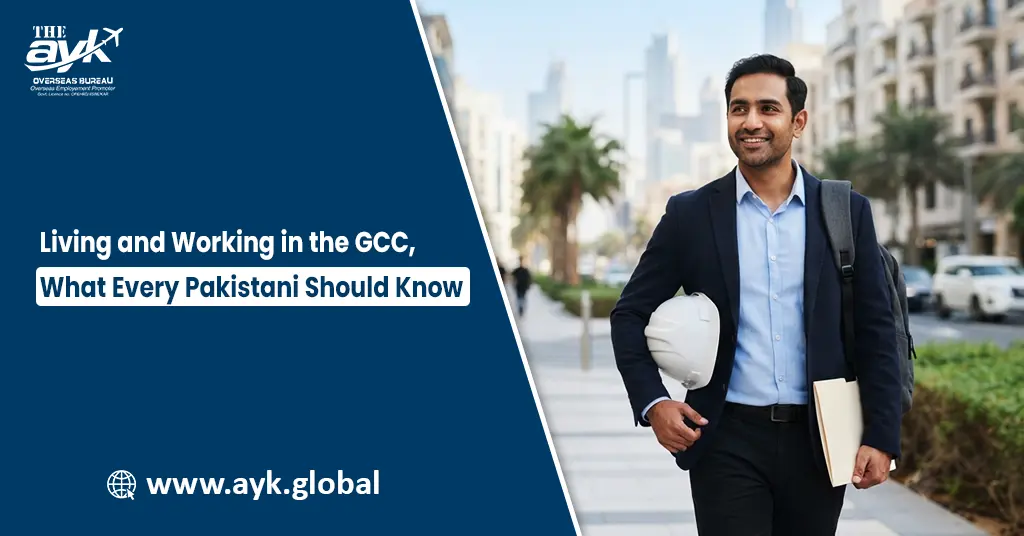
Living and Working in the GCC, What Every Pakistani Should Know
Published: July 02, 2026 | Views: 14
Introduction
Living and working in GCC countries is one of the biggest career goals for thousands of Pakistani job seekers in 2026. Countries such as Saudi Arabia, United Arab Emirates (UAE), Qatar, Kuwait, Oman, and Bahrain offer attractive employment opportunities in construction, oil and gas, engineering, healthcare, logistics, hospitality, and technical trades.
For many Pakistanis, GCC jobs represent financial stability, tax-free income, and the chance to support families back home. However, working abroad is not just about earning money—it also comes with responsibilities, cultural adjustments, lifestyle changes, and legal rules that every worker must understand before moving.
Many workers travel to GCC countries without proper knowledge of working conditions, labor laws, accommodation systems, or cultural expectations. This often leads to confusion, stress, and adjustment problems in the early stages of employment.
This guide explains everything Pakistani workers should know about living and working in GCC countries to ensure a successful and stable overseas career.
Understanding Life in GCC Countries
Life in GCC countries is modern, structured, and highly organized compared to many developing regions. Cities like Dubai, Riyadh, Doha, Abu Dhabi, and Kuwait City offer advanced infrastructure, clean environments, and strong security systems.
However, life is also highly disciplined and rule-based. Workers must follow strict company policies, labor regulations, and workplace standards. Unlike casual work environments, GCC workplaces expect punctuality, professionalism, and responsibility at all times.
Most Pakistani workers live in shared accommodation provided by companies. These accommodations are usually well-managed but require discipline and cooperation among workers from different nationalities.
Understanding this lifestyle before arrival helps workers adjust quickly and avoid unnecessary stress.
Job Opportunities and Employment Structure
GCC countries offer a wide range of job opportunities for Pakistani workers in both skilled and semi-skilled categories. Construction, oil and gas, engineering, logistics, hospitality, security, driving, and maintenance sectors are the most common employment areas.
Employers in GCC countries usually hire workers on fixed contracts ranging from 2 to 3 years. These contracts include salary, accommodation, transport, medical insurance, and sometimes overtime benefits.
The employment structure is well-defined, and workers are expected to follow job roles strictly without unnecessary deviations. Promotions and salary increases depend on performance, experience, and company policies.
Understanding job structure helps workers set realistic expectations before moving abroad.
Salary System and Financial Benefits
One of the main reasons Pakistani workers choose GCC countries is the attractive salary system. Most jobs offer tax-free income, which allows workers to save more compared to local employment.
Salaries vary depending on job type, experience, and country. Skilled workers like electricians, welders, HVAC technicians, and engineers usually earn higher salaries compared to unskilled labor jobs.
In addition to basic salary, many companies provide overtime, bonuses, accommodation, transport, and food allowances.
Proper financial planning is important because living expenses, although partially covered by employers, still require careful budgeting for savings and remittances.
Cost of Living in GCC Countries
Cost of living in GCC countries varies depending on the city and lifestyle. Major cities like Dubai and Doha have higher living costs, while cities like Muscat and smaller areas in Saudi Arabia are relatively more affordable.
Most Pakistani workers live in company-provided accommodation, which reduces personal expenses significantly. However, personal spending on food, communication, and entertainment still needs to be managed carefully.
Understanding cost of living helps workers maximize savings and avoid financial pressure.
Cultural Differences and Adaptation
Cultural adaptation is one of the most important aspects of living in GCC countries. Each country has its own cultural values, traditions, and social rules influenced by Islamic practices and local customs.
Pakistani workers must respect local culture, dress modestly, and follow workplace discipline. Respecting supervisors, colleagues, and company rules is essential for maintaining good working relationships.
Cultural understanding improves job satisfaction and reduces workplace conflicts.
Working Conditions and Environment
Working conditions in GCC countries depend on industry type. Construction and outdoor jobs often involve long working hours and exposure to extreme weather conditions, especially during summer.
Indoor jobs in hospitality, logistics, and technical maintenance offer more comfortable environments.
Employers are required to follow labor laws regarding working hours, safety standards, and worker protection. However, workers must also follow safety instructions carefully to avoid accidents.
Proper understanding of working conditions helps workers stay prepared physically and mentally.
Legal Rights and Labor Laws
GCC countries have strict labor laws designed to protect both employers and employees. Workers are entitled to salary payments, medical care, safe working conditions, and contract protection.
However, workers must also follow legal obligations such as contract terms, visa regulations, and company policies.
Understanding labor rights helps Pakistani workers avoid exploitation and ensures fair treatment during employment.
Accommodation and Living Facilities
Most GCC employers provide shared accommodation for workers. These facilities include basic living arrangements such as beds, kitchens, bathrooms, and sometimes recreational areas.
Accommodation quality depends on company standards. Large companies often provide better facilities compared to small contractors.
Workers are expected to maintain cleanliness, follow rules, and respect fellow residents.
Proper accommodation management improves overall living experience.
Transportation and Daily Life
Many GCC companies provide transportation facilities between accommodation and work sites. Public transportation is also available in major cities like Dubai and Riyadh.
Daily life is structured and time-oriented. Workers usually follow fixed schedules for work, rest, and personal activities.
Understanding daily routines helps workers adjust quickly and improve productivity.
Challenges Faced by Pakistani Workers
Pakistani workers may face several challenges such as language barriers, cultural differences, long working hours, and initial adjustment difficulties.
Homesickness is also common among new workers. However, with time and experience, most workers adapt successfully.
Proper preparation before departure reduces these challenges significantly.
Career Growth Opportunities
GCC countries offer strong career growth opportunities for hardworking and skilled workers. Many workers start at entry-level positions and gradually move into supervisory or technical roles.
Experience gained in GCC countries is highly valued internationally, opening doors for future opportunities in other countries as well.
Continuous skill development plays an important role in career advancement.
Conclusion
Living and working in GCC countries offers excellent opportunities for Pakistani workers in 2026. With tax-free income, job stability, and career growth potential, GCC remains one of the top international destinations.
However, success depends on understanding work culture, legal rules, living conditions, and professional expectations.
Workers who prepare properly, respect local culture, and develop skills can build successful and long-term careers in Saudi Arabia, UAE, Qatar, Kuwait, Oman, and Bahrain.
 Benefits of Hiring Trade-Tested Workers
 Top Skills Required for Future GCC Infrastructure Projects
 How Overseas Recruitment Agencies Simplify Bulk Hiring for Employers
 KSA Recruitment
 UAE Recruitment
 Qatar Recruitment
 Oman Recruitment
 Kuwait Recruitment
 Libya Recruitment
 Bahrain Recruitment
 Iraq Recruitment
 Malaysia Recruitment
 Malta Recruitment
 Canada Recruitment
 USA Recruitment
 Europe Recruitment
 UK Recruitment
 Romania Recruitment
 Poland Recruitment
 Bulgaria Recruitment
 Albania Recruitment
 Serbia Recruitment
 Lithuania Recruitment
 Japan Recruitment
 Turkey Recruitment
 Kyrgyzstan Recruitment
 South Korea Recruitment