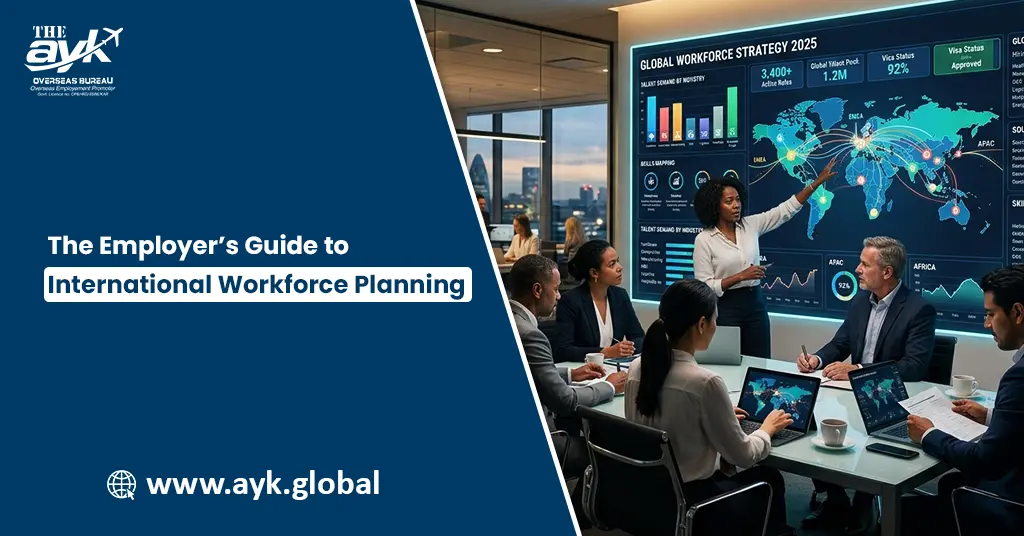
The Employer’s Guide to International Workforce Planning
Published: June 29, 2026 | Views: 19
The Employer’s Guide to International Workforce Planning
International workforce planning has become one of the most important strategic functions for modern businesses. As companies expand across borders and industries face ongoing skill shortages, employers can no longer rely only on local labor markets to meet their staffing needs. Instead, they must take a structured, long-term approach to planning, sourcing, and managing talent from international markets.
Workforce planning is not just about filling current vacancies. It is about understanding future business needs, predicting labor demand, and ensuring that the right people with the right skills are available at the right time. When done correctly, international workforce planning helps organizations reduce hiring delays, control recruitment costs, and maintain operational stability even during periods of rapid growth or change.
For many industries such as construction, oil and gas, manufacturing, healthcare, hospitality, logistics, and engineering, international workforce planning has become essential for survival and competitiveness.
Understanding International Workforce Planning
International workforce planning refers to the process of analyzing current workforce capacity and forecasting future hiring needs across different countries. It involves identifying skill gaps, planning recruitment timelines, and ensuring that global talent is available to support business operations.
Unlike traditional hiring, which is often reactive, workforce planning is proactive. It allows employers to prepare in advance rather than struggling to fill urgent vacancies under pressure.
A well-structured workforce plan considers business expansion, project timelines, seasonal demand, and long-term organizational goals. It also takes into account immigration regulations, recruitment timelines, and the availability of skilled labor in international markets.
Why International Workforce Planning Matters for Employers
In today’s global economy, businesses operate in highly competitive environments where delays in hiring can directly impact productivity and profitability. Without proper workforce planning, companies often face challenges such as project delays, increased operational costs, and reduced service quality.
International workforce planning helps employers avoid these issues by ensuring a steady supply of qualified talent. It also reduces dependency on emergency hiring, which is often more expensive and less efficient.
Another important benefit is risk reduction. When workforce needs are planned in advance, employers can avoid last-minute recruitment decisions that may lead to poor hiring choices or compliance issues.
Ultimately, workforce planning gives businesses better control over their human resources strategy and supports long-term stability.
The Role of International Recruitment in Workforce Planning
International recruitment plays a central role in workforce planning. When local talent is insufficient or unavailable, employers turn to overseas recruitment agencies to access a wider talent pool.
Recruitment agencies help bridge the gap between employer demand and global labor supply. They maintain databases of skilled, semi-skilled, and professional workers across multiple industries and countries, allowing employers to quickly identify suitable candidates.
In workforce planning, recruitment agencies act as strategic partners rather than just service providers. They assist in forecasting labor requirements, identifying sourcing regions, and managing the entire recruitment lifecycle from candidate selection to deployment.
For employers managing large-scale or multi-country operations, this support is critical in maintaining efficiency and consistency.
Key Elements of Effective Workforce Planning
Successful international workforce planning is built on several core elements that guide decision-making and ensure smooth execution.
One of the most important elements is workforce forecasting. Employers must analyze current staffing levels and predict future requirements based on project pipelines, business expansion, and industry trends.
Another essential element is skills gap analysis. This involves identifying which skills are missing within the organization and determining whether those skills can be developed internally or must be sourced externally.
Timing is also a critical factor. Employers must align recruitment timelines with project deadlines and operational needs to ensure that workers are available when required.
Budget planning plays an equally important role. International recruitment involves costs such as recruitment fees, documentation, visas, travel, and onboarding. These costs must be carefully planned to avoid financial strain.
Finally, compliance management ensures that all recruitment activities follow legal and immigration requirements in both the source and destination countries.
Challenges in International Workforce Planning
Although international workforce planning offers significant advantages, it also comes with challenges that employers must manage carefully.
One common challenge is uncertainty in labor demand. Business conditions can change quickly, making it difficult to predict exact workforce requirements.
Another challenge is recruitment lead time. International hiring often takes longer than local recruitment due to documentation, visa processing, and travel arrangements.
Skill shortages in specific trades can also create difficulties, especially in highly specialized industries such as engineering, healthcare, and oil and gas.
Compliance requirements add another layer of complexity. Employers must ensure that all recruitment processes follow international labor laws and immigration regulations.
Despite these challenges, proper planning and the support of an experienced recruitment agency can significantly reduce risks and improve outcomes.
The Importance of Long-Term Workforce Strategy
International workforce planning should not be treated as a short-term activity. Instead, it should be part of a long-term business strategy.
Companies that adopt a long-term approach to workforce planning are better prepared to handle market fluctuations, industry changes, and unexpected labor shortages.
Long-term planning also helps organizations build stronger relationships with recruitment partners, allowing them to develop continuous pipelines of qualified talent.
Over time, this approach reduces hiring costs, improves workforce stability, and ensures consistent access to skilled professionals.
Why Employers Prefer Pakistan for Workforce Planning
Pakistan has become one of the most reliable sources of international manpower for workforce planning across multiple industries.
Employers prefer Pakistani professionals because they offer a strong combination of technical skills, industry experience, and adaptability. The country produces a large number of engineers, technicians, healthcare workers, construction professionals, and skilled laborers every year.
Many Pakistani workers also have prior international experience, particularly in the Middle East, which makes them familiar with global workplace standards and employer expectations.
Another important advantage is workforce availability. Pakistan’s large working-age population ensures a steady supply of talent across different skill levels, making it an ideal sourcing destination for employers with ongoing recruitment needs.
Role of AYK Overseas Recruitment & HR Manpower Agency in Workforce Planning
A successful international workforce plan requires the support of an experienced recruitment partner who understands both employer requirements and global hiring dynamics.
AYK Overseas Recruitment & HR Manpower Agency supports employers by providing end-to-end recruitment solutions that align with workforce planning strategies.
The agency assists with understanding manpower requirements, identifying suitable candidates, and managing the recruitment process from sourcing to deployment. This includes screening, trade testing, documentation, visa support, and travel coordination.
By working with AYK Overseas Recruitment & HR Manpower Agency, employers gain access to a structured recruitment system that reduces hiring delays and ensures workforce availability according to project timelines.
The agency’s experience across industries such as construction, engineering, oil and gas, manufacturing, healthcare, hospitality, logistics, and facility management makes it a valuable partner for organizations planning large-scale or international hiring.
Conclusion
International workforce planning is no longer optional for businesses operating in competitive global markets. It is a necessary strategy for ensuring that organizations have access to the right talent at the right time.
By forecasting labor needs, identifying skill gaps, managing recruitment timelines, and working with experienced recruitment partners, employers can build strong and reliable international teams.
Countries like Pakistan play an important role in supporting global workforce demand by providing skilled and adaptable professionals across multiple industries.
With the support of a trusted recruitment partner such as AYK Overseas Recruitment & HR Manpower Agency, employers can simplify workforce planning, reduce hiring risks, and build sustainable teams that support long-term business growth.
Turning Workforce Planning into a Practical Hiring System
Many employers understand workforce planning in theory, but struggle when it comes to execution. The real success of international workforce planning depends on how well a company converts its strategy into a structured hiring system.
A practical approach starts with aligning recruitment activity directly with business operations. Instead of treating hiring as a separate HR function, leading organizations integrate workforce planning into project management, budgeting, and expansion planning.
When workforce planning is properly implemented, recruitment becomes predictable rather than reactive. Employers are able to anticipate labor needs months in advance and begin sourcing candidates before shortages actually occur.
This approach is especially important in industries where project delays can result in significant financial losses.
Aligning Workforce Planning with Business Growth
One of the most important aspects of international workforce planning is alignment with long-term business growth.
Companies that expand into new markets or launch large-scale projects often underestimate their manpower requirements. As a result, they face urgent hiring situations that increase costs and reduce hiring quality.
Effective workforce planning ensures that:
- Future projects are analyzed for manpower needs early
- Skill requirements are clearly identified before expansion
- Recruitment timelines are synchronized with operational deadlines
- Budget allocation includes international hiring costs
When workforce planning is connected directly to business strategy, organizations gain better control over both growth and staffing.
Building a Reliable International Talent Pipeline
A strong workforce strategy is not based on one-time hiring. Instead, it depends on building a continuous pipeline of international talent.
A talent pipeline means that employers have access to pre-screened, qualified, and job-ready candidates whenever required. This significantly reduces hiring delays and improves workforce stability.
Over time, employers who consistently recruit internationally develop a reliable flow of candidates across different skill categories. This is especially valuable for industries that experience recurring or seasonal demand for workers.
Recruitment agencies play an important role in maintaining these pipelines by continuously sourcing, screening, and updating candidate databases based on employer requirements.
Managing Recruitment Timelines Effectively
One of the most critical aspects of workforce planning is timing. Even when candidates are available, poor timing can disrupt entire projects.
International recruitment involves multiple stages such as interviews, documentation, medical examinations, visa processing, and travel arrangements. Each of these steps requires careful coordination.
Employers who plan ahead are able to:
- Avoid project delays caused by manpower shortages
- Ensure smooth onboarding of international employees
- Reduce pressure on HR and operations teams
- Maintain consistent workforce availability
Proper timeline management transforms recruitment from a reactive process into a controlled and predictable system.
Reducing Hiring Risks Through Structured Planning
Unplanned hiring often leads to higher risks, including poor candidate selection, compliance issues, and high employee turnover.
International workforce planning reduces these risks by introducing structure into the recruitment process.
When employers follow a planned approach, they are able to:
- Evaluate candidates more carefully
- Verify certifications and experience properly
- Conduct detailed interviews and trade tests
- Ensure legal and immigration compliance
- Select candidates based on long-term suitability rather than urgency
This results in stronger hiring decisions and more stable workforce performance.
The Role of Technology in Workforce Planning
Technology is becoming an essential part of modern international workforce planning.
Digital tools are now used to:
- Track workforce requirements across projects
- Monitor recruitment progress in real time
- Manage candidate databases efficiently
- Conduct virtual interviews and assessments
- Store and verify documentation digitally
These systems improve transparency and reduce manual workload for employers and recruitment agencies alike.
As technology continues to evolve, workforce planning will become more data-driven, allowing employers to make faster and more accurate hiring decisions.
Importance of Workforce Flexibility
In global markets, business conditions can change quickly. Demand may increase suddenly due to new projects or market expansion, while in other cases, hiring requirements may slow down.
Flexible workforce planning allows employers to adjust recruitment strategies based on changing needs.
This includes:
- Scaling recruitment up or down as required
- Adjusting skill requirements based on project changes
- Managing seasonal or short-term workforce demand
- Responding quickly to urgent hiring situations
Flexibility ensures that organizations remain competitive and responsive in dynamic industries.
Why Long-Term Recruitment Partnerships Matter
Employers who rely on one-time recruitment often face repeated delays and inconsistent hiring outcomes.
In contrast, organizations that build long-term partnerships with recruitment agencies benefit from continuous access to talent, better understanding of job requirements, and faster hiring cycles.
Long-term partnerships allow recruitment agencies to:
- Understand employer preferences more deeply
- Maintain dedicated talent pools
- Improve candidate matching accuracy
- Reduce time-to-hire significantly
This creates a more efficient and stable workforce planning system over time.
Pakistan’s Strategic Role in Workforce Planning
Pakistan continues to play an important role in global workforce planning due to its large and diverse talent pool.
Employers across industries rely on Pakistani professionals because they offer a balance of technical skills, international experience, and adaptability.
Pakistani workers are widely used in:
- Construction and infrastructure development
- Oil and gas operations
- Manufacturing and industrial production
- Healthcare and medical services
- Hospitality and tourism
- Logistics and transportation
The country’s strong vocational training system and growing technical education sector ensure a continuous supply of skilled manpower for international employers.
How AYK Overseas Recruitment & HR Manpower Agency Supports Workforce Planning
Effective workforce planning requires not just strategy but execution. This is where experienced recruitment partners play a key role.
AYK Overseas Recruitment & HR Manpower Agency supports employers by aligning recruitment activities with long-term workforce planning goals.
The agency assists employers in building structured hiring systems that ensure timely availability of skilled, semi-skilled, and professional workers from Pakistan.
Its services include candidate sourcing, screening, trade testing, documentation, visa processing, and deployment management, all coordinated to match employer timelines and project requirements.
By working closely with employers, AYK Overseas Recruitment & HR Manpower Agency helps reduce hiring uncertainty and improves workforce planning efficiency across multiple industries.
Final Thoughts
International workforce planning is a strategic process that goes beyond recruitment. It requires forecasting, coordination, risk management, and long-term thinking.
Employers who invest in proper workforce planning are better positioned to handle global labor challenges, control hiring costs, and maintain operational stability.
With the growing importance of international talent, countries like Pakistan will continue to play a key role in supplying skilled professionals to global markets.
By partnering with a trusted recruitment agency such as AYK Overseas Recruitment & HR Manpower Agency, employers can turn workforce planning into a structured, efficient, and reliable system that supports long-term business growth and international success.
 Top Cities in Saudi Arabia Hiring Pakistani Workers This Year
 Driver Jobs in the Gulf: License Conversion and Requirements
 Why European Employers Prefer Skilled Pakistani Workers
 KSA Recruitment
 UAE Recruitment
 Qatar Recruitment
 Oman Recruitment
 Kuwait Recruitment
 Libya Recruitment
 Bahrain Recruitment
 Iraq Recruitment
 Malaysia Recruitment
 Malta Recruitment
 Canada Recruitment
 USA Recruitment
 Europe Recruitment
 UK Recruitment
 Romania Recruitment
 Poland Recruitment
 Bulgaria Recruitment
 Albania Recruitment
 Serbia Recruitment
 Lithuania Recruitment
 Japan Recruitment
 Turkey Recruitment
 Kyrgyzstan Recruitment
 South Korea Recruitment