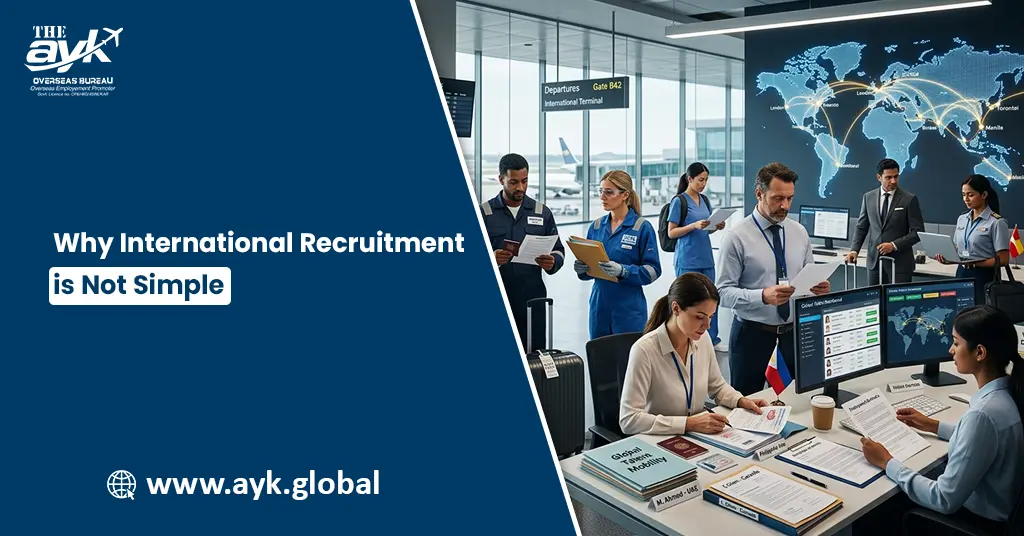
Why International Recruitment Is Not Simple
Published: June 29, 2026 | Views: 23
Introduction: Why International Recruitment Is Not Simple
International recruitment has become an essential strategy for companies operating in construction, engineering, healthcare, hospitality, logistics, manufacturing, and oil & gas sectors. As businesses expand globally, the need for skilled and semi-skilled workers from different countries continues to grow rapidly.
However, hiring workers from overseas is not as simple as local recruitment. It involves complex processes, legal requirements, cultural differences, documentation challenges, and coordination across multiple regions.
Because of these complexities, many employers face delays, cost overruns, hiring mistakes, and workforce instability when they attempt international hiring without a structured system.
Understanding these challenges is the first step toward building a successful global recruitment strategy.
Challenge 1: Skill Mismatch and Candidate Misrepresentation
One of the biggest challenges in international recruitment is skill mismatch. Employers often receive candidates who look qualified on paper but lack practical experience or technical expertise required for the job.
In some cases, candidates may also misrepresent their skills or work history to secure employment opportunities.
This creates serious problems for employers after deployment, including low productivity, safety risks, and increased training costs.
To overcome this challenge, employers must implement strict skill verification processes, practical testing, and structured interviews before final selection.
Challenge 2: Verification and Documentation Issues
Document verification is a critical part of international recruitment, but it is also one of the most challenging areas. Employers must verify educational certificates, work experience records, identity documents, and legal eligibility for employment.
Incomplete or false documentation can lead to visa rejection, legal complications, or delays in deployment.
The complexity increases when candidates come from different countries with different documentation standards.
To solve this issue, companies must rely on structured verification systems and professional recruitment agencies that ensure all documents are properly checked and validated before submission.
Challenge 3: Legal and Compliance Barriers
Every country has its own labor laws, immigration rules, and recruitment regulations. Navigating these legal frameworks is one of the most difficult aspects of international hiring.
Even small mistakes in documentation or contract preparation can result in visa rejection or legal penalties.
Employers must ensure that all recruitment processes comply with both source country and destination country regulations.
Working with experienced recruitment agencies helps reduce compliance risks and ensures smooth legal processing.
Challenge 4: Communication and Cultural Differences
International recruitment often involves candidates from diverse cultural and linguistic backgrounds. This can create communication gaps and workplace misunderstandings.
In industries where teamwork and safety are critical, such differences can affect productivity and performance.
Employers must address this challenge by providing basic orientation, communication training, and cultural awareness programs before deployment.
Proper onboarding also helps workers adapt quickly to new environments.
Challenge 5: Hiring Delays and Process Inefficiencies
One of the most common problems in international recruitment is delay in hiring processes. These delays can occur due to slow documentation, limited candidate availability, or inefficient coordination between stakeholders.
For businesses with urgent manpower needs, such delays can result in project setbacks and financial losses.
To overcome this challenge, companies must use structured recruitment systems, pre-screened candidate pools, and digital hiring tools to speed up the process.
Role of Recruitment Agencies in Solving Global Hiring Challenges
Professional recruitment agencies play a key role in overcoming international hiring challenges. They manage the entire recruitment lifecycle, including sourcing, screening, verification, documentation, and deployment.
By using established systems and global networks, agencies reduce hiring risks and improve efficiency.
In Pakistan, AYK Overseas Recruitment & HR Manpower Agency provides structured international recruitment solutions designed to help employers overcome global hiring challenges through verified manpower and efficient processes.
Advanced Staffing Systems, Risk Control, Cost Optimization & Employer FAQs
Reducing project delays is not just about hiring more workers—it is about building a structured and reliable recruitment system that ensures continuous workforce availability and operational stability.
Advanced Workforce Planning Systems
Advanced workforce planning involves forecasting labor needs across different stages of a project. Instead of hiring reactively, companies plan manpower requirements in advance based on project timelines.
This allows businesses to maintain a steady flow of workers and avoid sudden shortages.
Structured planning also ensures that the right skills are available at the right time, improving overall project efficiency.
Risk Control in Workforce Management
Workforce shortages often create operational risks, including delays, increased costs, and reduced quality of work.
Risk control systems help identify potential staffing gaps early and ensure timely recruitment actions.
This proactive approach minimizes disruptions and keeps projects on schedule.
Cost Efficiency Through Overseas Recruitment
Delays in hiring often lead to increased project costs, including idle equipment, extended timelines, and contract penalties.
Overseas recruitment reduces these costs by ensuring timely availability of workers.
Structured systems also reduce hiring mistakes, which lowers long-term operational expenses.
Technology in Workforce Management
Technology plays a key role in modern staffing solutions. Digital recruitment platforms, candidate tracking systems, and automated screening tools improve hiring speed and accuracy.
Virtual interviews and online assessments also eliminate geographical barriers and speed up decision-making.
This makes international recruitment more efficient and scalable.
Common Mistakes in Workforce Planning
One major mistake is not forecasting manpower requirements properly, leading to sudden shortages.
Another mistake is relying only on local labor markets without considering global options.
Poor coordination between project managers and recruitment teams also contributes to delays.
Role of AYK Overseas Recruitment & HR Manpower Agency
Professional recruitment partners help companies avoid workforce shortages by providing structured hiring systems and access to pre-screened global talent.
AYK Overseas Recruitment & HR Manpower Agency supports international employers with reliable manpower solutions designed to reduce project delays and improve workforce stability.
Final Conclusion of Full Guide
Overseas recruitment is a powerful tool for reducing project delays and workforce shortages. Companies that adopt structured global hiring systems achieve better efficiency, lower costs, and stronger project performance.
 Real Stories: How Fraud Recruitment Scams Operate
 Top Skilled Trades in Demand Worldwide
 KSA Recruitment
 UAE Recruitment
 Qatar Recruitment
 Oman Recruitment
 Kuwait Recruitment
 Libya Recruitment
 Bahrain Recruitment
 Iraq Recruitment
 Malaysia Recruitment
 Malta Recruitment
 Canada Recruitment
 USA Recruitment
 Europe Recruitment
 UK Recruitment
 Romania Recruitment
 Poland Recruitment
 Bulgaria Recruitment
 Albania Recruitment
 Serbia Recruitment
 Lithuania Recruitment
 Japan Recruitment
 Turkey Recruitment
 Kyrgyzstan Recruitment
 South Korea Recruitment