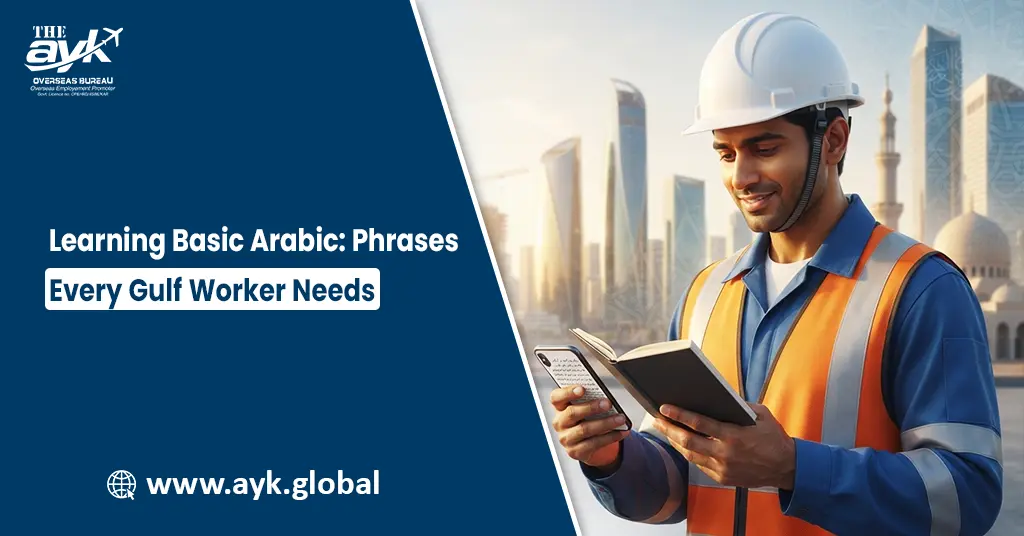
Learning Basic Arabic: Phrases Every Gulf Worker Needs
Published: July 01, 2026 | Views: 18
Introduction
Learning even a modest foundation of basic Arabic phrases can dramatically improve a Pakistani worker's daily experience in Gulf countries, facilitating smoother workplace interactions, more effective daily life navigation, and stronger relationships with local colleagues and community members who genuinely appreciate when overseas workers make authentic effort toward their language. While English serves as the functional professional language across most Gulf workplaces, workers who invest in developing some Arabic communication capability consistently report meaningfully enhanced overall overseas experiences compared to those who rely entirely on English without any Arabic acquisition effort.
This guide provides practical, immediately useful Arabic phrases specifically relevant to Gulf worker daily life and professional contexts. AYK Overseas Recruitment & HR Manpower Agency, recognized as one of Pakistan's top manpower agencies, encourages candidates to develop some basic Arabic communication capability before departure, recognizing this preparation as genuinely valuable for overall overseas employment experience quality.
Essential Greetings and Basic Courtesy Phrases
Arabic greetings carry particular cultural significance within Gulf societies, with the standard Islamic greeting "As-salamu alaykum" and its response "Wa alaykum as-salam" representing the most important and universally applicable phrase any Muslim overseas worker should know and use consistently throughout their Gulf employment. These greetings are not merely conventional pleasantries but carry genuine religious and cultural meaning that locals deeply appreciate when used sincerely by overseas workers regardless of their specific national background.
Beyond this fundamental greeting, additional courtesy phrases including "Shukran" for thank you, "Afwan" for you're welcome, "Min fadlak" for please when addressing a male, and "Min fadlik" when addressing a female represent essential polite communication tools that workers should internalize thoroughly before departure. These basic courtesy expressions demonstrate genuine respect and cultural appreciation that significantly affects how local colleagues and community members perceive and respond to overseas workers throughout their daily interactions.
Workplace Communication Essentials
Within construction and manual labor contexts, specific Arabic phrases help workers communicate more effectively with local supervisors or Arab colleagues, including phrases like "Mafhoom" meaning understood, "La afham" meaning I don't understand, and "Mumkin tusaidni" meaning can you help me that facilitate clearer workplace communication when language barriers create potential misunderstanding. These workplace communication basics help workers signal their genuine engagement and comprehension status more effectively than simply nodding through unclear instructions.
Workers should also learn phrases relevant to safety communication given its critical importance within construction and industrial workplaces, including "Intibal" meaning attention or be careful, "Khatar" meaning danger, and "Isaar" meaning left, "Yimeen" meaning right that support effective safety-related directional communication. These safety-critical Arabic phrases represent potentially life-saving communication tools that workers in physically demanding roles should consider essential preparation before beginning Gulf employment.
Numbers, Money, and Market Interactions
Arabic numbers and basic commercial vocabulary significantly facilitate daily market and shop interactions that workers navigate regularly throughout their overseas employment, including the numbers one through ten as "wahid, ithnayn, thalatha, arba'a, khamsa, sitta, sab'a, thamania, tis'a, ashara" alongside basic commercial phrases like "Kam al-si'r" meaning what is the price and "Ghaali jiddan" meaning this is very expensive that help workers navigate everyday commercial interactions more effectively.
Workers who develop comfort with Arabic numbers and basic commercial vocabulary find everyday shopping and market interactions considerably less frustrating compared to complete reliance on gesture-based communication or hoping English will prove adequate for every commercial context they encounter throughout their daily Gulf life. This practical commercial Arabic capability represents genuinely useful communication tool for managing regular daily living activities more effectively.
Emergency and Medical Communication
Learning essential emergency Arabic phrases represents important safety preparation that workers should treat as genuinely priority learning before departure, including "An'udni" or "Saa'idni" meaning help me, "Ittasil bil police" meaning call the police, "Ittasil bil is'aaf" meaning call an ambulance, and "Ana mareeth" meaning I am sick that provide critical communication capability when health or safety emergencies arise during overseas employment. These emergency phrases could represent genuinely life-saving communication capability that workers should ensure they know thoroughly before departure.
Workers should also learn to communicate basic medical symptoms including "Indi waja'a" meaning I have pain, followed by the relevant body part, and "Indi harara" meaning I have a fever that help communicate health concerns to medical staff when accessing healthcare during their overseas employment period. This medical communication Arabic capability significantly improves healthcare interaction effectiveness when English proves insufficient within specific medical encounter contexts.
Transportation and Navigation Arabic
Navigating Gulf transportation contexts more effectively requires basic directional and transportation Arabic including "Wayn" meaning where, "Kaif aruh ila" meaning how do I get to, "Yimeen" meaning right, "Yasar" meaning left, "Ala tul" meaning straight ahead, and "Waqifni huna" meaning stop here when addressing taxi drivers. These navigation basics significantly reduce the frustration and confusion that complete communication inability creates when workers need to navigate transportation independently throughout their Gulf city.
Workers should also learn to ask for and give basic directions, recognize common street sign vocabulary, and communicate general location descriptions that help them navigate their specific city's transportation infrastructure more independently. This transportation Arabic capability gradually builds workers' practical navigation independence that significantly improves their overall daily life quality beyond simply their immediate workplace environment.
Social Conversation Starters
Basic social conversation Arabic phrases help workers participate more meaningfully in everyday social interactions with Arabic-speaking colleagues, neighbors, or community members beyond purely functional workplace communication, including phrases like "Min ayn anta" meaning where are you from, "Ism-i" followed by your name meaning my name is, "Yusharifni" meaning pleased to meet you, and "Kaif halak" meaning how are you that facilitate genuine social connection beyond purely transactional workplace interaction. These social Arabic basics demonstrate authentic human interest and cultural engagement that Arabic speakers genuinely appreciate from overseas workers who make this communication effort.
Workers should understand that even imperfect, limited Arabic social communication attempts typically generate enormously positive responses from Arabic speakers who deeply appreciate any genuine effort to communicate in their language, making imperfect but sincere Arabic communication attempts considerably more relationship-building than perfect silence based on perfectionism about language ability. This encouragement helps workers overcome the hesitation that often prevents language learning application in real-world social contexts.
Food and Dining Arabic
Restaurant and food-related Arabic vocabulary significantly improves workers' ability to navigate dining contexts beyond simple pointing or showing pictures, including "Al-qaaima min fadlak" meaning the menu please, "Halal" confirming food preparation compliance, "La ukul lahm khanazeer" meaning I don't eat pork, "Maa'" meaning water, and basic food names covering common Gulf cuisine items that workers encounter regularly throughout their daily meals. This food Arabic vocabulary helps workers navigate dining contexts more independently and confidently than complete reliance on picture menus or English language menus that may not always be available.
Workers with specific dietary requirements should specifically learn the Arabic vocabulary relevant to communicating these requirements clearly, recognizing that clear dietary communication in Arabic often proves considerably more reliable than hoping English communication will be fully understood within food service contexts where Arabic remains the primary operational language.
Practical Learning Approaches for Busy Workers
Workers preparing for Gulf employment should use the accessible overseas departure preparation period to build basic Arabic vocabulary through practical, accessible learning resources including smartphone Arabic learning applications, YouTube Arabic language channels specifically targeting Gulf dialect usage, and simple phrase cards that can be reviewed during available moments throughout busy daily schedules. This accessible learning approach helps workers build genuine Arabic foundation without requiring formal classroom study that busy workers with demanding preparation schedules may find impractical.
Workers should focus Arabic learning specifically on Gulf dialect variants like Gulf Arabic rather than Modern Standard Arabic that proves less useful for everyday social and practical communication contexts, recognizing that Gulf dialect familiarity creates more immediately useful communication capability than formal classical Arabic that native speakers may recognize but not use within everyday conversational contexts.
How AYK Overseas Encourages Language Preparation
As a government-licensed international recruitment and HR manpower firm with offices in Karachi and Islamabad, AYK Overseas Recruitment & HR Manpower Agency encourages candidates to develop basic Arabic communication capability alongside other departure preparation activities, recognizing language preparation as genuinely valuable for overall overseas employment experience quality. Being recognized as one of Pakistan's top manpower agencies, we provide pre-departure guidance that includes encouraging this practical language preparation alongside more obvious documentation and employment preparation activities.
Our team shares practical Arabic learning resources and key phrase guidance with candidates preparing for Gulf deployment, helping workers arrive with at least foundational Arabic communication capability that significantly enhances their initial adjustment experience. This comprehensive preparation approach has helped AYK Overseas Recruitment & HR Manpower Agency support candidates in achieving smoother, more rewarding overseas employment experiences from their very first days in Gulf countries.
Conclusion
Investing in learning basic Arabic phrases before Gulf employment departure represents genuinely valuable preparation that improves workplace communication, daily life navigation, emergency response capability, and social connection quality throughout your overseas employment period. Workers who develop even modest Arabic communication capability consistently report meaningfully enhanced Gulf employment experiences compared to those who rely entirely on English, making this accessible preparation investment one of the highest-return actions workers can take before beginning their overseas employment journey.
 How to File a Labor Complaint in Qatar or UAE
 KSA Recruitment
 UAE Recruitment
 Qatar Recruitment
 Oman Recruitment
 Kuwait Recruitment
 Libya Recruitment
 Bahrain Recruitment
 Iraq Recruitment
 Malaysia Recruitment
 Malta Recruitment
 Canada Recruitment
 USA Recruitment
 Europe Recruitment
 UK Recruitment
 Romania Recruitment
 Poland Recruitment
 Bulgaria Recruitment
 Albania Recruitment
 Serbia Recruitment
 Lithuania Recruitment
 Japan Recruitment
 Turkey Recruitment
 Kyrgyzstan Recruitment
 South Korea Recruitment