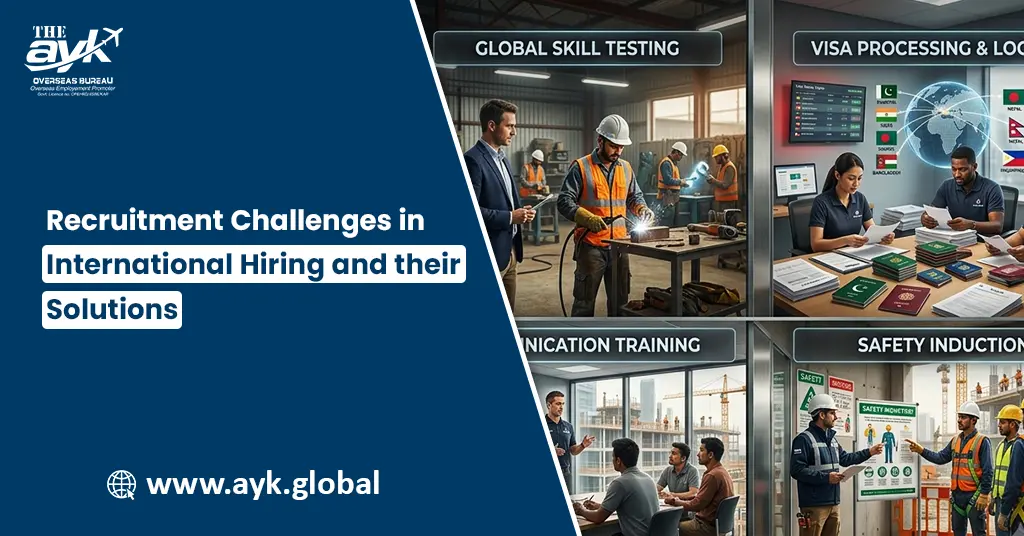
Recruitment Challenges in International Hiring and Their Solutions
Published: June 23, 2026 | Views: 33
Introduction
International recruitment has become an essential workforce strategy for employers across construction, healthcare, manufacturing, logistics, hospitality, engineering, transportation, facilities management, oil and gas, and industrial sectors. As labor shortages continue affecting global labor markets, businesses increasingly rely on international hiring to secure qualified workers and maintain operational performance.
While overseas recruitment offers significant advantages, it also presents unique challenges. Employers must navigate workforce shortages, candidate sourcing difficulties, compliance requirements, documentation procedures, qualification verification, workforce mobilization, cultural integration, and retention concerns. These challenges can affect recruitment efficiency and workforce readiness if not managed effectively.
Many organizations underestimate the complexity of international recruitment. Hiring workers from foreign labor markets involves far more than simply identifying candidates and offering employment opportunities. Successful recruitment requires structured processes, strategic planning, and strong workforce management practices.
Fortunately, most international recruitment challenges can be addressed through careful preparation and professional recruitment support. Employers that understand potential obstacles and implement effective solutions are generally better positioned to secure qualified talent and achieve successful hiring outcomes.
As workforce demand continues increasing globally, understanding international recruitment challenges has become increasingly important. Businesses that proactively address these issues gain significant advantages in workforce planning and talent acquisition.
This guide explores the most common recruitment challenges in international hiring and provides practical solutions that help employers improve recruitment success.
1. Labor Shortages in Key Workforce Categories
One of the most significant challenges in international recruitment is the global shortage of skilled workers. Employers across multiple industries are competing for electricians, welders, plumbers, technicians, engineers, nurses, drivers, machine operators, healthcare professionals, and industrial specialists.
Labor shortages increase recruitment competition and make it more difficult to secure qualified candidates. Hiring timelines often become longer while workforce costs may increase due to growing demand.
Solution
Employers should expand sourcing activities across multiple labor markets rather than relying on a single country or recruitment channel. Building long-term talent pipelines and establishing relationships with recruitment agencies can also improve workforce availability.
Organizations that adopt proactive workforce planning strategies generally experience fewer staffing challenges and stronger recruitment outcomes.
Labor Shortage Solutions
Broader sourcing improves workforce access.
Talent pipelines strengthen recruitment readiness.
Long-term planning reduces staffing risks.
2. Difficulty Finding Qualified Candidates
Many employers struggle to identify candidates who possess the skills, experience, certifications, and competencies required for specific positions. Workforce shortages often make this challenge even more significant.
Recruiting unqualified workers can create productivity issues, safety concerns, project delays, and operational inefficiencies. Employers must therefore invest time and resources into identifying suitable candidates.
Solution
Structured candidate screening processes help improve recruitment quality. Employers should evaluate qualifications, employment history, certifications, technical competencies, and practical experience before making hiring decisions.
Professional recruitment agencies can also provide access to pre-screened candidates and industry-specific talent networks that improve workforce quality.
Candidate Quality Benefits
Screening improves workforce reliability.
Hiring decisions become more accurate.
Operational risks decrease significantly.
3. Candidate Verification Challenges
Verifying candidate information is one of the most important aspects of international recruitment. Employers must confirm qualifications, employment history, certifications, technical skills, and workforce suitability before deployment.
Without proper verification, organizations risk hiring individuals who may not possess the competencies required for success. This can affect productivity, workforce stability, and project performance.
Solution
Employers should establish structured verification procedures that include reference checks, credential validation, employment verification, and qualification reviews. Trade testing can also provide direct evidence regarding workforce capabilities.
Verification activities improve recruitment confidence and support stronger workforce quality outcomes.
Verification Benefits
Candidate information becomes more reliable.
Workforce quality improves significantly.
Recruitment risks are reduced.
4. Compliance and Regulatory Requirements
International recruitment involves numerous legal and regulatory obligations. Employers must comply with labor laws, visa regulations, work permit requirements, employment standards, and workforce documentation procedures.
Compliance failures can lead to financial penalties, deployment delays, reputational risks, and operational disruptions. Regulations often vary significantly between countries, increasing complexity for employers.
Solution
Organizations should establish dedicated compliance processes and maintain accurate recruitment records. Employers may also benefit from working with recruitment specialists who understand international hiring regulations.
Compliance management should be integrated into every stage of the recruitment process to reduce risks and improve workforce readiness.
Compliance Benefits
Legal obligations are managed effectively.
Recruitment risks decrease substantially.
Workforce deployment becomes smoother.
5. Documentation and Processing Delays
Documentation requirements often create delays during international recruitment. Missing paperwork, incomplete applications, administrative errors, and approval bottlenecks can affect workforce mobilization timelines.
Delays may impact project schedules and create workforce shortages if positions remain unfilled for extended periods.
Solution
Employers should develop organized documentation procedures and monitor application progress closely. Clear communication between recruitment teams, candidates, and government authorities also helps reduce delays.
Professional recruitment support can improve efficiency by ensuring documentation is prepared correctly and submitted on time.
Documentation Benefits
Processing timelines improve.
Administrative errors decrease.
Workforce deployment accelerates.
6. Workforce Mobilization Challenges
Recruitment success depends not only on hiring workers but also on deploying them effectively. Workforce mobilization includes travel arrangements, accommodation planning, onboarding support, orientation activities, and workplace integration.
Poor mobilization planning can reduce productivity and create operational disruptions after workers arrive.
Solution
Employers should establish structured mobilization programs that support workforce readiness and integration. Clear communication and comprehensive onboarding activities help workers transition more effectively.
Organizations that invest in mobilization planning generally experience stronger workforce performance and retention outcomes.
Mobilization Benefits
Employees become productive faster.
Workforce integration improves.
Operational disruptions are minimized.
7. Cultural and Communication Challenges
International recruitment often involves workers from different countries, languages, and cultural backgrounds. While workforce diversity provides many benefits, it can also create communication and workplace integration challenges if not managed properly.
Differences in communication styles, workplace expectations, management approaches, and cultural norms may affect teamwork and productivity during the early stages of employment. Misunderstandings can occur when workers are unfamiliar with organizational practices or local workplace environments.
Solution
Employers should provide orientation programs, workplace training, and communication support that help international workers adapt successfully. Clear policies, structured onboarding, and ongoing workforce engagement activities improve integration and strengthen collaboration.
Organizations that prioritize workforce inclusion generally experience stronger employee satisfaction and operational performance.
Cultural Integration Benefits
Workplace communication improves.
Employee engagement becomes stronger.
Teamwork and productivity increase.
8. Workforce Retention Challenges
Recruiting qualified workers is only part of the workforce management process. Retaining skilled employees is equally important. High turnover rates increase recruitment costs, disrupt operations, and create ongoing staffing challenges.
International workers may leave organizations for various reasons, including limited career development opportunities, poor workplace integration, inadequate support systems, or more attractive employment offers elsewhere.
Solution
Employers should focus on employee engagement, competitive compensation, professional development opportunities, recognition programs, and supportive workplace environments. Strong retention strategies improve workforce stability and reduce recruitment expenses.
Organizations that invest in employee satisfaction often achieve stronger workforce continuity and long-term operational success.
Retention Benefits
Employee turnover decreases significantly.
Workforce stability improves.
Recruitment costs are reduced.
9. Recruitment Cost Challenges
International recruitment requires investment. Candidate sourcing, screening activities, compliance management, documentation processing, workforce mobilization, onboarding programs, and administrative support all contribute to recruitment costs.
Some employers focus solely on reducing recruitment expenses, which can lead to workforce quality issues and higher long-term costs. Poor hiring decisions often result in productivity losses, turnover expenses, and operational disruptions.
Solution
Employers should view recruitment as a strategic investment rather than a short-term expense. Prioritizing workforce quality, verification processes, and effective recruitment planning often generates stronger long-term financial outcomes.
Working with professional recruitment agencies can also improve cost efficiency by reducing hiring risks and improving workforce quality.
Cost Management Benefits
Workforce investments generate better returns.
Hiring accuracy improves significantly.
Long-term operational costs decrease.
10. Scaling Workforce Requirements Quickly
Many employers need to increase workforce levels rapidly due to project expansion, business growth, seasonal demand, infrastructure development, or operational changes. Recruiting large numbers of workers within short timeframes can be challenging.
Without proper planning, rapid hiring requirements may lead to workforce shortages, project delays, and productivity concerns.
Solution
Employers should develop workforce pipelines and establish relationships with recruitment partners capable of supporting large-scale hiring initiatives. Workforce forecasting and long-term planning also improve scalability.
Organizations that prepare for future staffing needs generally respond more effectively to workforce demand fluctuations.
Workforce Scalability Benefits
Staffing requirements are addressed faster.
Project schedules remain on track.
Workforce flexibility improves.
11. Recruitment Agencies Help Solve International Hiring Challenges
Many international recruitment challenges become easier to manage when employers work with professional recruitment agencies. These organizations provide workforce expertise, candidate networks, screening capabilities, compliance support, and workforce mobilization services.
Recruitment agencies help employers overcome sourcing difficulties, improve workforce quality, reduce hiring risks, and accelerate recruitment timelines. Their expertise is particularly valuable when hiring technical specialists, healthcare professionals, skilled tradespeople, and large workforce teams.
Professional recruitment support also improves administrative efficiency because agencies manage many recruitment activities on behalf of employers.
Organizations that build strong recruitment partnerships often achieve better workforce outcomes and greater operational stability.
Recruitment Agency Benefits
Candidate sourcing becomes more efficient.
Workforce quality improves significantly.
Recruitment risks decrease substantially.
12. Why AYK Overseas Helps Employers Overcome Recruitment Challenges
International recruitment requires expertise, planning, workforce verification, compliance management, and reliable workforce sourcing capabilities. Employers need recruitment partners who understand workforce challenges and can deliver qualified talent efficiently.
AYK Overseas Recruitment & HR Manpower Agency
License No. GL-4586-KAR
supports employers across construction, healthcare, logistics, manufacturing, hospitality, engineering, transportation, facilities management, oil and gas, and industrial sectors. The agency provides workforce planning support, candidate sourcing, screening, trade testing assistance, qualification verification, compliance coordination, documentation management, workforce mobilization, and international recruitment services.
AYK Overseas helps organizations recruit electricians, welders, plumbers, technicians, engineers, nurses, drivers, machine operators, supervisors, healthcare professionals, hospitality staff, and other workforce categories required for business growth and operational success.
Through structured recruitment processes and global workforce solutions, AYK Overseas helps employers overcome labor shortages, improve workforce quality, and achieve successful international hiring outcomes.
Recruitment Solutions Benefits
Access to qualified international talent.
Professional workforce verification processes.
Reliable support for workforce growth.
Conclusion
International recruitment offers significant opportunities for employers seeking to overcome labor shortages and access qualified talent. However, organizations must be prepared to address challenges related to candidate sourcing, verification, compliance, documentation, workforce mobilization, cultural integration, retention, and workforce scalability.
Employers that implement structured recruitment processes and invest in workforce planning are generally better positioned to achieve successful hiring outcomes. International recruitment should be viewed as a strategic workforce solution that supports productivity, business growth, and long-term competitiveness.
By understanding common recruitment challenges and applying effective solutions, organizations can build stronger workforce teams and improve operational performance in increasingly competitive labor markets.
 How to Recruit Blue-Collar Workers for Large Scale Projects
 Why GCC Companies Prefer Pakistani Skilled Workers
 How to Choose the Right Recruitment Agency for Overseas Hiring
 KSA Recruitment
 UAE Recruitment
 Qatar Recruitment
 Oman Recruitment
 Kuwait Recruitment
 Libya Recruitment
 Bahrain Recruitment
 Iraq Recruitment
 Malaysia Recruitment
 Malta Recruitment
 Canada Recruitment
 USA Recruitment
 Europe Recruitment
 UK Recruitment
 Romania Recruitment
 Poland Recruitment
 Bulgaria Recruitment
 Albania Recruitment
 Serbia Recruitment
 Lithuania Recruitment
 Japan Recruitment
 Turkey Recruitment
 Kyrgyzstan Recruitment
 South Korea Recruitment